
The Three O'Clock Hour
If you find yourself hitting the wall around 3pm,you're not alone.
That all too familiar afternoon energy crash is often blamed on age, stress or a busy schedule. But for many adults over 40, the real reasons may lie deeper. There are genuine biological reasons behind the crash. Learn what may be behind it — and what you can do about it.
Part One — The Crash
A familiar story — but it doesn't have to be that way.

Work, family, the schedule that never quite stops — and a body quietly running on borrowed reserves.
You wake early. The day starts well — coffee, perhaps two, a decent run at the inbox. By midday you are still composed. Then, somewhere between two and four, the lights dim from the inside. Concentration thickens. The shoulders settle. A third coffee promises rescue and delivers, briefly, before the floor gives way again around four-thirty.
This is the mid-afternoon energy crash, and it is now so common among adults over 40 that most people accept it as simply the cost of a full life — deadlines, bills, teenagers, aging parents, the slow attrition of sleep. The cost is real. But the crash itself is not inevitable.
It is a downstream symptom of three converging pressures modern life places on the cardiovascular and cellular systems: chronic stress, declining physical movement, and a poor diet — often accompanied by alcohol — that quietly starves the body of the raw materials it needs to make energy properly. The fix is not another stimulant. The fix is upstream.

What it costs
The hidden cost of the mid-afternoon energy crash.
When your energy and focus disappears mid-afternoon, the effects extend far beyond feeling tired. Work takes longer. Concentration fades. Frustrations feel bigger. The gym gets postponed and health eating gives way to take-out.
Over time healthy habits become harder to maintain. Good intentions are replaced by easier choices. And because it happens gradually, many people simply accept it as part of modern life.
When the afternoon crash and low energy becomes a daily pattern, it can quietly influence the quality of your day, your health, your relationships and the choices you make.

"Just one more, then I'll get back to it."
Part Two — The Stimulant Trap
Why the third coffee doesn't quite work.
Caffeine does not give the body energy. It blocks the receptors that tell the brain it is tired. Adenosine, a molecule that accumulates through the day, normally docks into those receptors and slows neural firing — the brain's honest signal that rest is due. Caffeine is shaped just like adenosine, so it occupies the parking space without delivering the message.
The body responds by manufacturing more receptors. Tolerance builds. The adrenal system, meanwhile, is asked to keep releasing cortisol and adrenaline to maintain the illusion of vigor. Blood sugar rises, then falls. The pancreas answers with insulin. An hour or two later, the crash arrives — sharper than the one caffeine was meant to prevent.
Sugar, energy drinks and the newer stimulant blends work along the same axis: borrowed energy, repaid at interest. Over years, repeated cycles contribute to elevated resting heart rate, disturbed sleep architecture, blood-pressure variability, and a gradual hollowing-out of the body's own energy machinery. It is a poor trade, especially after forty, when the margins narrow.
Part Three — A Different Mechanism
Nitric oxide: the body's own quiet engineer.
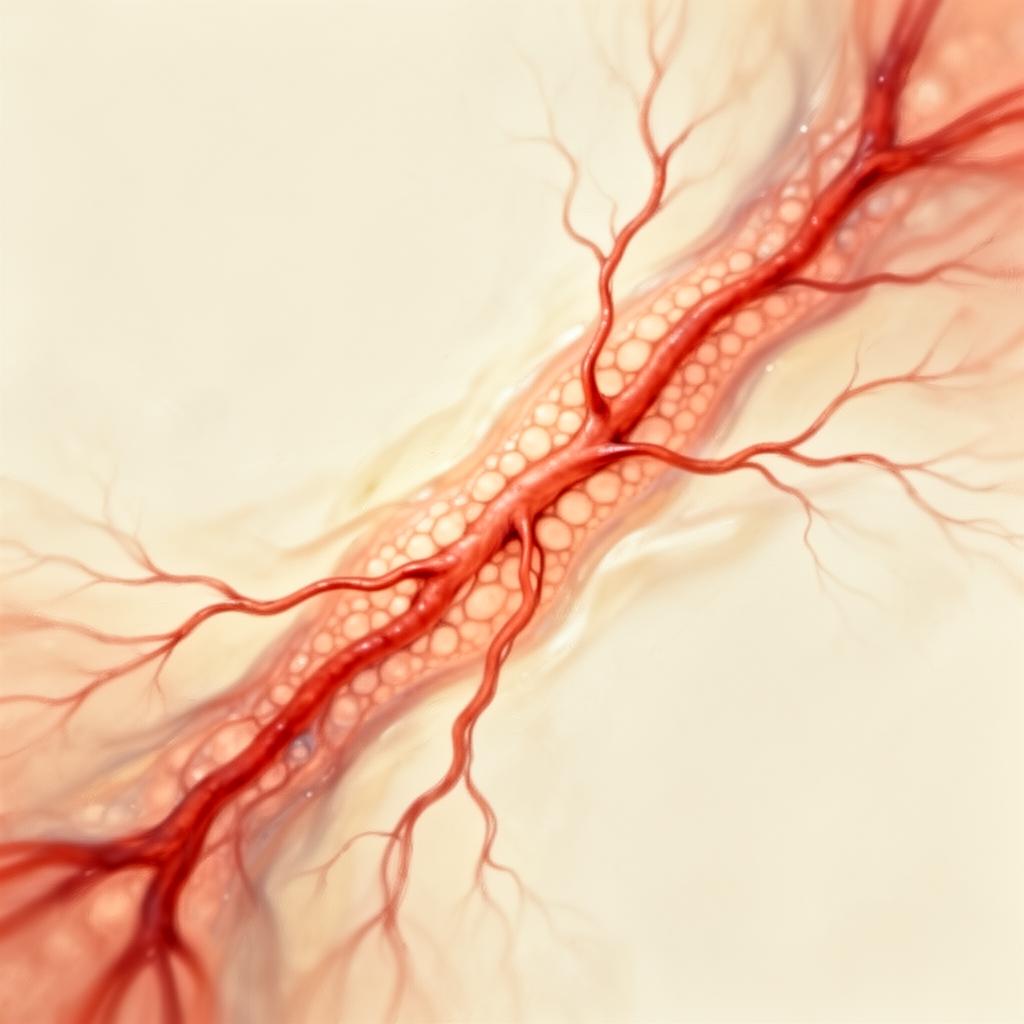
In 1998 the Nobel Prize in Physiology or Medicine was awarded for the discovery that a simple gas — nitric oxide, or NO — acts as a signaling molecule in the cardiovascular system. It was a remarkable finding. A gas, made on demand by the thin endothelial lining of every blood vessel in your body, quietly orchestrating circulation, oxygen delivery and cellular communication.
Nitric oxide tells blood vessels to relax and widen, a process called vasodilation. Wider, more pliant vessels mean more oxygen and more nutrients reaching every tissue — muscles, organs, and most importantly for our story, the mitochondria inside each cell where energy is actually made.
Unlike caffeine, nitric oxide does not push the system harder. It opens the channels through which the system already wants to work. The result is energy that arrives without urgency and leaves without a debt.
1998 Nobel Prize
Awarded to Furchgott, Ignarro and Murad for the discovery of nitric oxide as a signaling molecule in the cardiovascular system.
Part Four — Inside The Cell
Where energy is actually made.

Every cell in the body — somewhere between thirty and forty trillion of them — contains tiny power stations called mitochondria. They take oxygen and glucose (or fat) and, through a process known as oxidative phosphorylation, produce adenosine triphosphate, or ATP. ATP is the universal currency of energy. Every thought, heartbeat and footstep is paid for in it.
Mitochondrial efficiency depends on two things: a steady supply of oxygen, and a smoothly running electron transport chain. Nitric oxide is involved in both. It widens the vessels that deliver the oxygen and it helps modulate mitochondrial respiration itself — calibrating how efficiently cells convert fuel to ATP, and reducing the oxidative "exhaust" (free radicals) that damages the mitochondria over time.
After forty, mitochondrial density and function naturally decline. The endothelium produces less nitric oxide. Circulation stiffens. Cells receive marginally less oxygen, make marginally less ATP, and produce marginally more oxidative stress. Multiply that across trillions of cells and you have, almost precisely, the felt experience of the three o'clock crash.
miles of blood vessels lined by NO-producing endothelium in the adult body.
approximate decline in endothelial NO production between ages 40 and 70.
of cellular ATP is produced in the mitochondria via oxidative phosphorylation.
Part Five — A Comparison
Borrowed energy, or natural sustained energy.
Reasons We Don't Want Stimulants
Caffeine, sugar, energy blends
- Block adenosine receptors — mask fatigue rather than resolve it.
- Provoke cortisol and adrenaline release; tax the adrenal system.
- Cause blood-sugar volatility and reactive insulin spikes.
- Disturb sleep architecture, compounding next-day fatigue.
- Build tolerance; require ever-larger doses for the same effect.
Nitric Oxide Pathway
Endothelial support, mitochondrial efficiency
- Widens vessels — more oxygen and nutrients delivered, naturally.
- Supports mitochondrial respiration; more ATP per breath.
- Stable blood-sugar response; no reactive crash.
- Improves sleep quality through better circulation and lower vascular load.
- No tolerance, no dependency, no diminishing returns.


Part Six — A Considered Solution
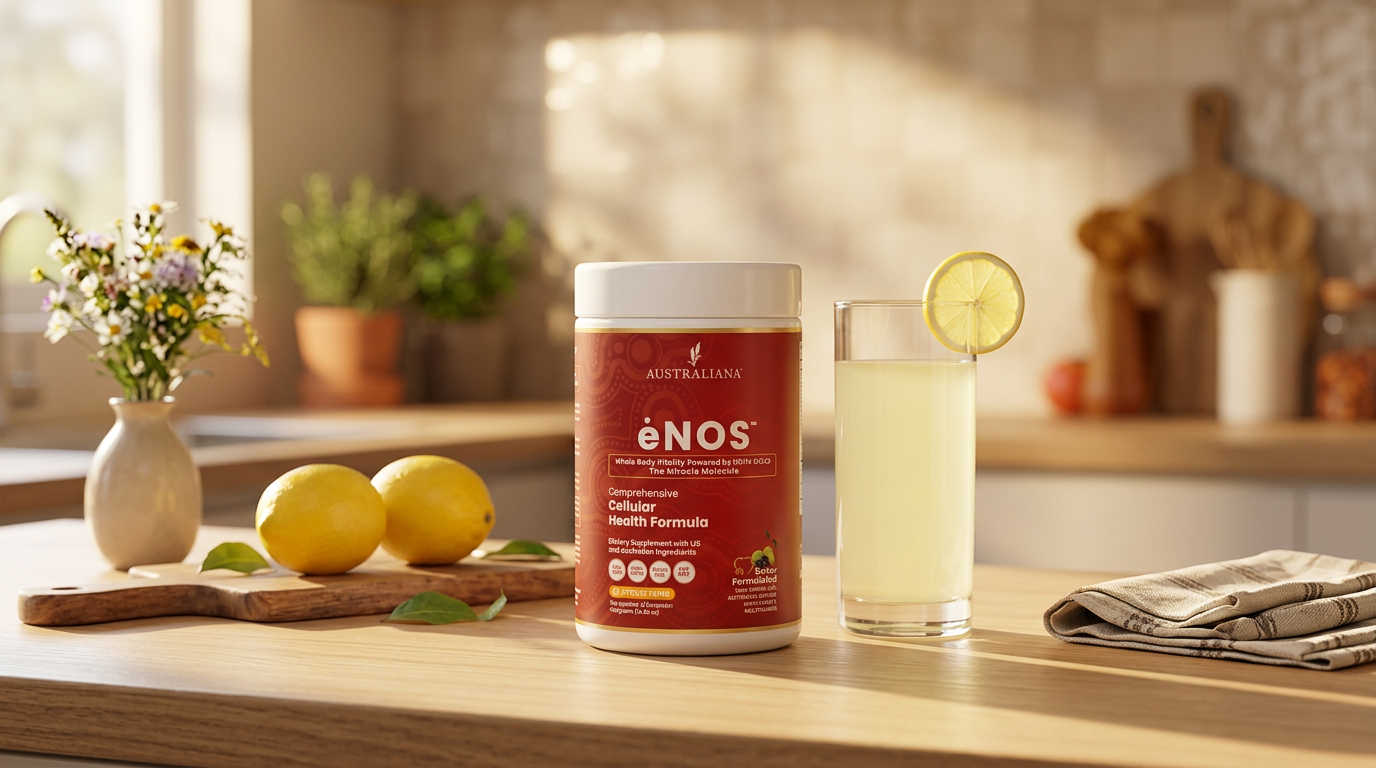
Why ėNOS – the supplement?
The enzyme that produces nitric oxide on the endothelial lining of your blood vessels is called endothelial nitric oxide synthase. ėNOS, the supplement, takes its name from that same enzyme — and is formulated for a single, specific purpose: to give the body the raw materials it needs to produce nitric oxide on demand, the way it did more easily in earlier decades.
ėNOS is a delicious powdered nutritional drink formulated to support the body's natural nitric oxide pathway. It provides L-arginine and L-citrulline — the primary amino acid precursors used by the endothelium to produce nitric oxide — together with carefully selected vitamins, minerals and antioxidant nutrients that support endothelial health and nitric oxide production.
Unlike stimulants, that temporarily block tiredness receptors and triggers a false sense of energy, the goal of ėNOS is different. It is designed to support the physiological processes involved in healthy circulation and nitric oxide production, delivering oxygen and nutrients to every cell at the mitochondrial level, helping the body function the way it was designed to deliver natural sustained energy.
ėNOS is not intended to replace healthy lifestyle habits. ėNOS combined with regular exercise and good nutrition remain the foundations of energy and vitality.
Continuing The Conversation
You received this from someone who thought it might matter to you.
For more information refer to the person who shared this link.
Thank you for reading. Nitric oxide is one of the most important discoveries in modern physiology, and its relevance to overall health, wellness, natural energy and vitality, is only growing as the research deepens.